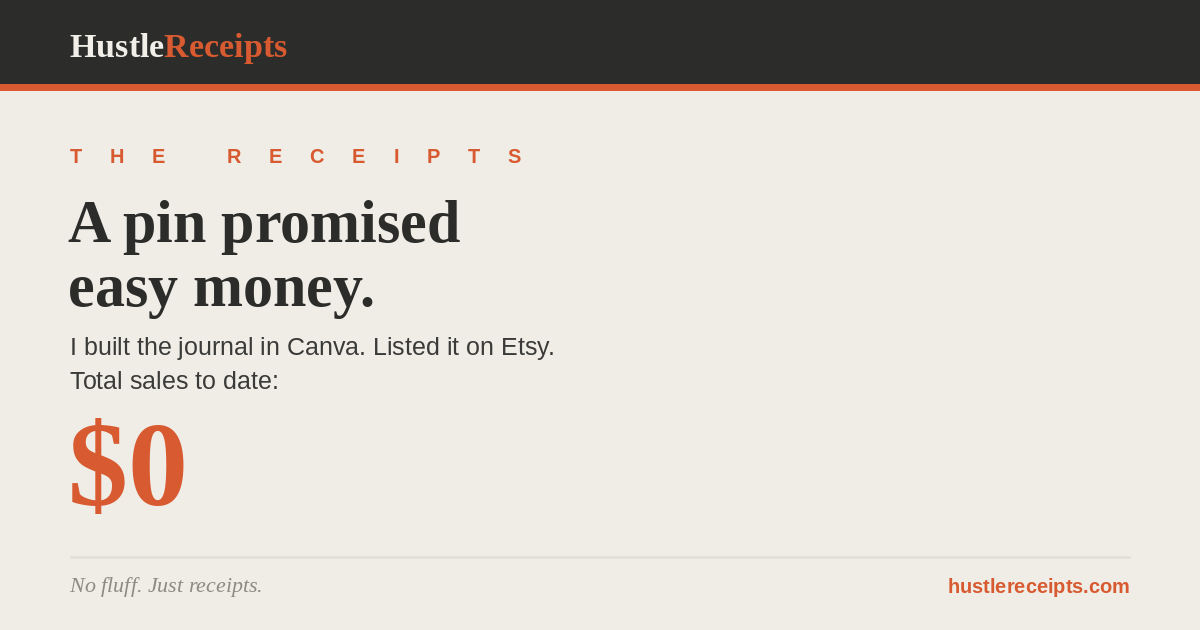
A pin told me I could make easy money selling journals and planners. Design once, list it, collect passive income while you sleep. No inventory, no shipping, beginner-friendly.
I believed it enough to actually do it. This post is the receipt — and the receipt says $0.
I'm not writing this to complain. I'm writing it because the "how" is genuinely simple, the pins are right about that part, and they stop exactly where the truth starts. So here's the whole thing: how I built it, how I listed it, what it earned, and why I think it earned nothing.
How I made the journal (in Canva)
This part really is easy. That's the trap, but it's also true.
I made a 30-Day Wellness Journal entirely in Canva's free tier. The steps:
Pick a size. I set a custom canvas at 8.5×11 inches — US Letter — because that's what people print printables on. Get this right first; resizing later reflows everything.
Design one interior page, well. A printable journal isn't 30 unique pages, it's one good repeating layout. Mine had a daily wellness spread: date, a water tracker, a mood line, a few gratitude prompts, space to write. The whole product lives or dies on this one page.
Duplicate to fill the book. Once the daily page worked, I duplicated it out to 30 days and added a cover and a short intro page.
Export as a print-ready PDF. Canva's "Download → PDF Print" gives you a single file ready to sell. Done.
Start to finish, this was an afternoon. Which is exactly why the pins make it sound like free money — the production cost is almost nothing.
How I listed it on Etsy as a digital download
Also easy. Etsy is built for this.
When you create a listing, you mark it as a digital item and upload the file (Etsy lets you attach up to five files per listing). After someone buys, Etsy delivers the download automatically — you're not emailing anyone anything. No packaging, no shipping label, no trip to the post office.
Then the listing itself: a title, up to 13 tags, a description, a price (printables usually run $3–$10), and a few mockup images showing the pages. I set mine up, hit publish, and it went live. The mechanics took maybe twenty minutes.
And then I waited.
The receipt
Here's the honest accounting, which is the whole point of this blog.
Sales: 0. Revenue: $0.
The only money that has actually moved on this hustle moved out — Etsy's $0.20 listing fee, which renews every four months whether anything sells or not. So the true net is a few cents in the red.
That's it. That's the receipt the pin never shows you.
Why it made nothing
This is the useful part, because the zero wasn't bad luck. It was predictable, and I can see exactly why now.
I did the easy half and skipped the hard half. Making the journal was the easy 20%. The hard 80% — getting it found and getting someone to want it — I didn't do at all. The pin sold me the easy 20% as the whole job.
"Journal" and "planner" are among the most saturated categories on Etsy. There are tens of thousands of them, including free ones. A brand-new listing with no sales and no reviews lands on page forty of search, where no one looks. Being live is not the same as being seen.
Passive doesn't mean no marketing. "Sells while you sleep" skips the part where you first have to drive people to the listing — SEO, Pinterest, an audience. I had none of that pointed at it. A digital download with no traffic is a file sitting in a folder nobody can find.
I made what the pin told me to make, not what a specific buyer was searching for. "Wellness journal" is broad and generic. The listings that actually sell niche down hard and solve a specific person's specific problem. I validated nothing before I built — the same lesson I learned the expensive way once before.
What I'd actually do differently
The journal is still up. It's still at zero. And the lesson is worth more than the sale would've been: "easy to make" got sold to me as "easy to sell," and those are completely different problems.
If I tried this again, I'd flip the order. Find a specific, underserved niche and confirm people are searching for it before opening Canva. Build the listing around what they actually type into the search bar. And treat the whole thing as a traffic-and-demand problem, not a design project — because the design was never the hard part.
When this listing makes its first dollar — if it ever does — I'll publish that too. But I'm not going to pretend the easy version is the real version. The pin already does that.
Made something a pin promised would be easy money — and it wasn't? Tell me what it was. I'm collecting these. Hit reply or drop a comment.
Leave a comment